
OVERVIEW
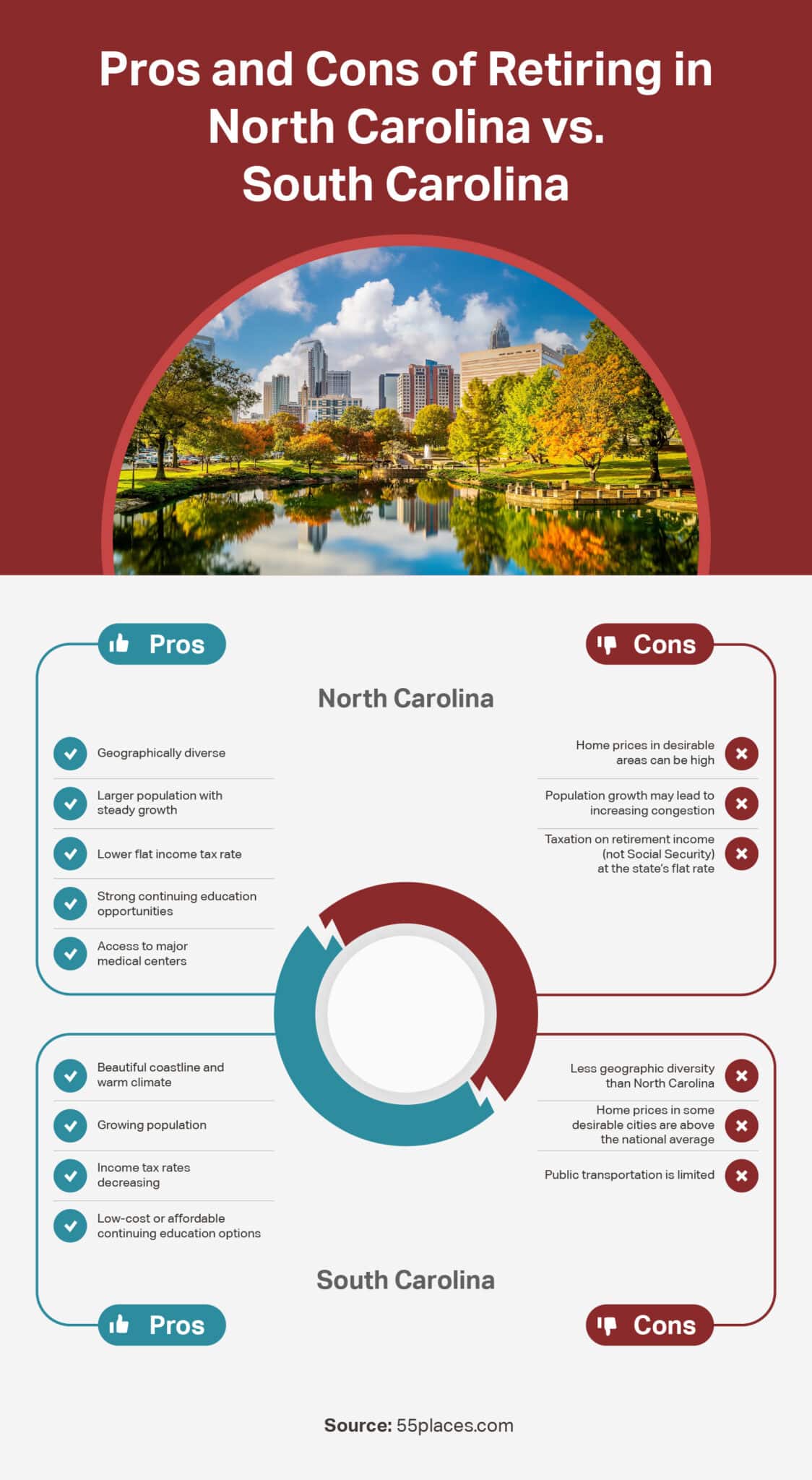
North Carolina and South Carolina both rank among the top retirement destinations in the Southeast, but they differ on cost and access. South Carolina posts a cost-of-living index of 92.7 and 55+ median list prices starting near $299,900, while North Carolina’s index of 96.7 buys larger metros, more hospitals, and mountain-to-coast geography. Both states exempt Social Security from state income tax.
If you’re thinking about a move to the Carolinas, you’re not alone. But choosing between North Carolina and South Carolina can feel like a big decision. Both states offer scenic landscapes, welcoming communities, and a cost of living that appeals to many active adults. To help you get a clearer sense of what each state offers, we’ve broken down some key pros and cons so you can decide which place feels right for your next chapter.
Let’s take a look.
History of North Carolina and South Carolina

Given the names of North Carolina and South Carolina, one might assume there was once a single state called “Carolina” that split into two. While a larger colonial territory known as the Province of Carolina existed, the story is more nuanced.
Initially chartered in 1663, the Province of Carolina spanned a very large tract of land under the control of eight Lords Proprietors, according to NCpedia. In its early decades, the territory faced many challenges, including weak governance, corruption, geographic isolation, rebellion, and piracy.
In 1712, the colony was formally divided into separate jurisdictions: The northern half became North Carolina and the southern half became South Carolina, according to NCpedia. As for the American Revolution: Yes, both North Carolina and South Carolina (as colonial entities) took part in the struggle for independence from Britain. They were among the original 13 colonies.
Mountains, Coastlines, and Landscapes
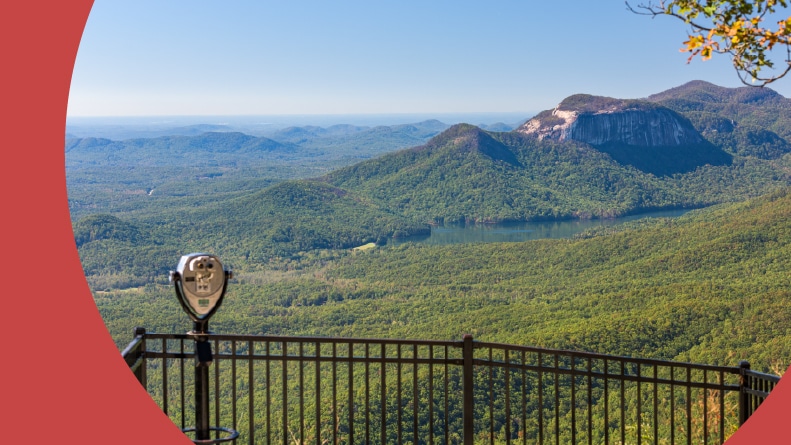
North Carolina has often been praised for its geographic variety. Within a matter of hours, you could leave the coast, head into the Piedmont region, and be in the mountains before nightfall. Average travel time ranges from six to 10 hours, depending on the destination. Several islands also lie off the coast.
South Carolina isn’t quite as diverse, but it’s no less beautiful. It still has mountain ranges, such as Sassafras Mountain, but they’re much smaller. South Carolina is better known for its gorgeous coastline.
That geography shapes everyday life for active adults. In western North Carolina, you can spend a morning on a mountain trail or a lake and still be home in time for lunch. Along the South Carolina coast, the milder Lowcountry climate keeps golf and beach season open for much of the year. The Grand Strand near Myrtle Beach and the courses around Hilton Head put tee times and shoreline walks within easy reach.
For many active adult homebuyers, the decision comes down to a simple question: Do your days lean toward the mountains or the water?
Population Growth in North Carolina vs. South Carolina

Both North Carolina and South Carolina are experiencing a slight population boom. The U.S. Census Bureau reports that South Carolina’s population is 5.57 million as of 2025, with about 21% of residents age 65 and older.
North Carolina has experienced an even more significant population boom. The U.S. Census Bureau states North Carolina’s population is 11.2 million as of 2025, with about 19% of residents age 65 and older.
For active adults considering a move, population growth can signal expanded services, new housing options, and continued investment in local amenities. Steady growth in both Carolinas also suggests long-term stability, an important factor when choosing a 55+ community for retirement.
Lifelong Learning in North Carolina and South Carolina

North Carolina
Now that you are retired, you may be interested in continuing your education. Whether you’re looking to earn a new degree or want to learn something new, North Carolina offers numerous opportunities for active adults seeking a new adventure.
The Osher Lifelong Learning Institute at NC State University (OLLI) offers non-credit courses for individuals who are 50 and older. At OLLI, you can take short courses, go on trips, and attend special events. You can take a single course or courses up to six weeks long. There is no major push to take courses to pass classes, and it’s mostly about learning for the love of it.
UNC Asheville offers another OLLI college, known as The College for Seniors. Much like the courses offered at NC State University, it’s all about following your passions.
South Carolina
South Carolina offers its own education system for active adults who want to learn more. Even better is the fact that many of them won’t cost you a dime.
The College of Charleston has the Center for Creative Retirement. These college courses aren’t free, but they cost only $60 per academic year. There are weekly presentations, tours, trips, book groups, and more.
Greenville Technical College also offers courses for active adults known as the Plan 60 Option. To be eligible, you must be 60 and older and not work full-time. You must also be a legal resident of South Carolina. If you qualify, you can take most of the primary curriculum and continuing opportunity courses, but you’ll still pay student fees, technology fees, and book/materials fees.
Tax Comparison for Retirees: North Carolina vs. South Carolina

For 2026, North Carolina’s flat individual income tax rate is 3.99%, down from 4.25% in 2025 and 4.5% in 2024, according to the North Carolina Department of Revenue. Because it’s a flat rate, all taxpayers pay the same 3.99% on taxable income, regardless of income level.
South Carolina’s income tax works a little differently, according to the South Carolina Department of Revenue. For 2026, the state uses two brackets: 1.99% on taxable income under $30,000 and 5.21% on taxable income of $30,000 or more, minus $966. The top rate has fallen in recent years, from 7% in 2021 to 6.2% in 2024 and 6% in 2025.
Both North Carolina and South Carolina exempt Social Security benefits from state income tax, according to the North Carolina and South Carolina departments of revenue. This can reduce the state income tax burden for retirees who rely on Social Security. In North Carolina, most other taxable retirement income, including distributions from IRAs and 401(k)s, is generally subject to the state’s flat income tax rate, although certain government retirement benefits are exempt under the state’s Bailey decision. South Carolina offers additional deductions that can reduce the taxable portion of retirement income for residents age 65 and older.
For 55+ homebuyers comparing the two states, these policies can influence long-term affordability and help clarify how far retirement savings may stretch in each location.
Cost of Living: North Carolina vs. South Carolina
Taxes are only part of the affordability picture. According to the MERIC second-quarter 2026 Cost of Living Index, North Carolina has an overall cost-of-living index of 96.7, compared with 92.7 in South Carolina. Both are below the national average of 100, but South Carolina’s lower housing costs help drive its lower overall index.
The 55+ home-price tables listed below make the trade-off concrete. In South Carolina, median listing prices for homes in 55+ communities start around $299,900 in the Asheville–Greenville area, according to 55places.com’s August 2026 market report. Comparable North Carolina markets like Raleigh-Durham and Charlotte have median listing prices of $534,415 and $529,000, respectively.
Here’s what that means in practice. South Carolina often stretches a housing budget further, while North Carolina’s larger markets offer more hospitals, airports, and services for the higher price. The right pick depends on whether affordability or big-city access matters more for your next chapter.
Best Places to Retire in North Carolina and South Carolina
North Carolina
Among North Carolina’s retirement destinations, Cary is a standout for active adults, thanks to its proximity to medical facilities and moderate living costs. Home prices here sit at the higher end of the state’s range, which reflects steady demand and the area’s appeal to active adults.
Other places to consider for retiring in North Carolina include Concord and Winston-Salem. Concord is conveniently located near several hospitals, while Winston-Salem offers a wealth of historical sites, with numerous museums and historical places to explore. It’s also close to bigger cities like Greensboro.
55+ Communities in Cary, NC
- Acclaim at Cary Pointe
- Blakeley
- Carolina Preserve
- Corbinton at Kildaire Farm
- Everstead
- Heritage Pines
- The Courtyards at Kildaire Farms
- The Courtyards at Lochmere
- The Courtyards at O’Kelly Chapel
- The Courtyards at West Cary
- The Townes at West Cary
- Woodhall
55+ Communities in Concord, NC
55+ Communities in Winston-Salem, NC
Median List Price of a Home in a 55+ Community in North Carolina, August 2026
| Area | Median List Price |
|---|---|
| Asheville-Greenville Area | $449,500 |
| Charlotte Area | $529,000 |
| Myrtle Beach-Wilmington Area | $509,500 |
| Raleigh-Durham Area | $534,415 |
| Southern Pines Area | $365,500 |
| Winston-Salem-Greensboro Area | $420,000 |
South Carolina
In the Upstate, Greenville, South Carolina stands out as one of the best places to retire in the state, with a walkable downtown, a mild climate, and a growing arts and dining scene. Home prices run above the national average, in step with the area’s rising popularity.
Rock Hill is another strong option for retiring in South Carolina. Homes there tend to cost less than the national average, and the moderate climate and easy driving access make day-to-day life simple.
Related Article: The Best-Reviewed 55+ Communities in South Carolina
55+ Communities in Greenville, SC
- Annandale Estates
- Arden Woods Villas
- Del Webb Greenville
- Overture Greenville
- Rosalia Verdae
- Swansgate
55+ Communities in Rock Hill, SC
Median List Price of a Home in a 55+ Community in South Carolina, August 2026
| Area | Median List Price |
|---|---|
| Asheville-Greenville Area | $299,900 |
| Charleston Area | $452,490 |
| Columbia-Augusta Area | $400,000 |
| Myrtle Beach-Wilmington Area | $392,000 |
| Savannah-Hilton Head Area | $525,000 |
FAQ: North Carolina vs. South Carolina for Retirement
Is North Carolina or South Carolina better for retirees?
Both states are excellent retirement destinations. North Carolina offers more geographic variety and larger metro areas, while South Carolina is known for lower overall taxes and coastal living. The right choice depends on your climate preferences, budget, and lifestyle.
Does North Carolina or South Carolina have lower taxes for retirees?
South Carolina generally offers more retiree-friendly tax breaks, including substantial deductions on retirement income. North Carolina has a lower flat tax rate, but the state taxes most retirement income except Social Security.
Does North Carolina or South Carolina have a better cost of living?
South Carolina usually wins in affordability, especially for housing and everyday expenses. North Carolina is moderately priced but tends to be more expensive around major cities like Raleigh and Charlotte.
Are the beaches better in North Carolina or South Carolina?
South Carolina is famous for beaches like Hilton Head and Myrtle Beach. North Carolina offers the Outer Banks and many quieter beach towns known for natural beauty and fewer crowds.
Is the climate better in North Carolina or South Carolina?
North Carolina offers more seasonal variety, including cooler mountain weather. South Carolina is generally warmer and more humid, especially in the Lowcountry and coastal regions.
Does North Carolina or South Carolina have better health care?
North Carolina generally ranks higher for health care, with nationally recognized systems in Raleigh-Durham, Winston-Salem, and Charlotte. South Carolina also has quality care, but fewer top-ranked hospitals.
Is there more outdoor recreation in North Carolina or South Carolina?
North Carolina offers mountains, lakes, beaches, and hiking trails. South Carolina emphasizes coastal recreation, golf, and water activities. Both states are great for year-round outdoor lifestyles.
Are home prices cheaper in North Carolina or South Carolina?
South Carolina is typically more affordable, especially for budget-conscious buyers. North Carolina home prices are higher in metro areas but remain reasonable compared to many other states.
Which state has better continuing education opportunities for adults 55 and older?
North Carolina offers robust lifelong-learning programs (such as OLLI at NC State and UNC Asheville). South Carolina also offers excellent programs, but often with lower enrollment costs.
How do I choose between North Carolina and South Carolina for retirement?
Compare climate, cost of living, taxes, health care access, and lifestyle priorities. Visiting each area and touring 55+ communities can help you determine which state best aligns with your retirement goals.
How much money do you need to retire comfortably in South Carolina?
It depends mostly on housing, which is the biggest variable. In South Carolina’s 55+ communities, median list prices generally run from about $299,900 in the Upstate to around $525,000 near Hilton Head, so your home choice sets the baseline. From there, South Carolina’s retiree-friendly taxes and its Social Security exemption help keep ongoing costs down. A comfortable budget ultimately comes down to where you buy and the lifestyle you want.
Which town in South Carolina is best for retirement?
No single winner exists, but a few stand out. Greenville and Rock Hill draw active adults who want an inland base with a walkable downtown and easy driving. For a coastal lifestyle, the Myrtle Beach and Hilton Head areas pair beach access with golf courses and a milder year-round climate. The best fit depends on whether you picture your days by the water or closer to a city.
North Carolina vs. South Carolina: Which State Is Best for Your Retirement?
If you’re ready to explore more of what the Carolinas have to offer, 55places.com can help you take the next step with confidence. Our trusted 55places real estate experts can introduce you to even more communities, compare retirement destinations, and help you find the setting that truly fits your lifestyle.
When you’re ready to discover what’s next, contact us today to connect with a 55places.com Partner Agent who understands the needs of today’s active adults.

- Insights and market stats
- Instant new home alerts
- Answers from local 55+ experts