HIGHLIGHTS
- Georgia’s overall cost of living runs about 10% below the national average, with housing more than 20% lower, making it the more budget-friendly pick.
- Florida charges no state income tax, giving it the edge on retirement-income savings.
- Neither Georgia nor Florida levies an estate or inheritance tax.
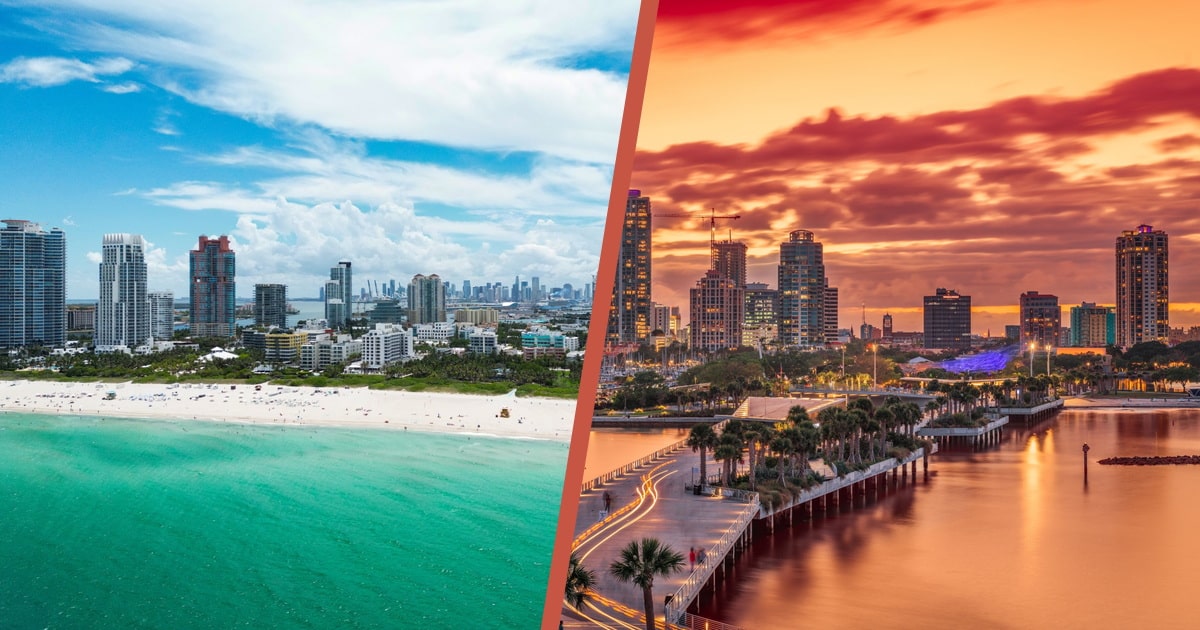
- Georgia pairs Blue Ridge Mountains with a coastline, while Florida offers 8,436 miles of shoreline and more than 1,100 golf courses.
The Southeastern U.S. has become a magnet for retirees, thanks to its mild climate, ample outdoor recreation, affordable living, and wide selection of 55+ communities. Among the top destinations, Georgia and Florida stand out as two of the most popular options for active adults. But when it comes to retirement lifestyle, cost of living, and retirement taxes, each state offers different advantages.
If you’re weighing your options, it’s important to look beyond the beaches and mountains. Understanding how taxes, housing, health care access, and community amenities compare can help you make the most informed choice for your long-term financial and lifestyle goals. Read on for a side-by-side breakdown of what to expect when retiring in Georgia versus Florida.
Georgia vs. Florida at a Glance: What’s the Difference?
Here’s how the two states stack up on the factors retirees weigh most:
| Category | Georgia | Florida |
|---|---|---|
| Overall cost of living | 9.9% below the national average (ranks 11th) | 0.8% above the national average (ranks 32nd) |
| Housing cost | 22.4% below the national average | Roughly at the national average |
| State income tax | Flat 4.99% (excludes Social Security benefits) | None |
| Social Security tax | Fully exempt | No state income tax |
| Estate/inheritance tax | None | None |
| Property tax rate | 0.72% of a home’s assessed value | 0.78% of a home’s assessed value |
| Climate | Warm, with cooler and occasionally freezing winters up north | Warm year-round, with winters averaging around 75 degrees |
| Hurricane exposure | Lower, mainly along the coastal region | Highest of any state |
| Signature scenery | Blue Ridge and Appalachian mountains plus 2,344 miles of shoreline | 8,436 miles of shoreline and more than 1,100 golf courses |
| Top-ranked hospitals | Emory University Hospital, Northside Hospital Forsyth, Northeast Georgia Medical Center | Mayo Clinic Florida, Tampa General Hospital, UF Health Shands Hospital |
Cost of Living and Affordability

The decision between Georgia and Florida requires a thorough look at financial factors, especially for retirees who rely on a fixed income from sources such as Social Security benefits. Generalizing the cost of living for an entire state can be tricky, since expenses often differ greatly between counties, cities, and communities.
However, using MERIC’s Q2 2026 data, we can compare the average cost of living for the two states to the national average. Doing so helps put affordability into perspective.
Housing
Georgia is especially affordable when it comes to housing, with costs 22.4% lower than the national average. Florida housing, on the other hand, is roughly in line with the national average, at 0.7% below it. Georgia also has lower grocery and transportation costs than Florida, with both categories below the national average in Georgia.
Utilities and Health Care
Georgia may trend toward cost-effectiveness, but Florida has a slight edge on utilities. Utility costs in Florida are 2.5% below the national average and slightly lower than Georgia. Health care costs are close to the national average in Georgia, at 0.2% above it, while Florida’s are 2.8% above the national average.
Overall Affordability
Georgia ranks 11th in the country, while Florida ranks 32nd for overall affordability. Georgia’s cost-of-living index is 9.9% below the national average, while Florida’s is 0.8% above the national average.
Because affordability varies widely by area within each state, retirees should seek advice from trusted real estate agents and financial advisors.
Taxes and Financial Benefits

Everyone loves talking about taxes, right? Not exactly, but taxes are an important consideration when choosing where to retire. Both Florida and Georgia offer benefits to active adults looking to save on their dues. Here’s a breakdown of some important information on Georgia vs. Florida retirement taxes:
Florida Taxes
- No income tax (including no taxes on retirement income and benefits)
- No inheritance or estate taxes
- Average state and local sales tax: 7%
- Property taxes average 0.78% of a home’s assessed value
- Homestead exemption can exclude up to $50K from property taxes
Georgia Taxes
- Individual income tax includes a flat 4.99% in 2026 (excludes Social Security and Railroad Retirement benefits)
- Retirement income may be exempt up to $65k for residents 62 and older (if conditions are met), an exclusion that applies on top of the Social Security exemption
- No inheritance or estate taxes
- Average state and local sales tax: 7.49%
- Property taxes average 0.79% of a home’s assessed value
- Homestead exemption of up to $4,000 for those 65 and older (if conditions are met)
Overall, both states can be considered tax-friendly for retirees, which is why Georgia and Florida remain popular retirement destinations.
Related Article: Should Residents of 55+ Communities Pay Less Property Tax?
Climate and Weather

Active adults choose Georgia and Florida for retirement, in part because both states offer year-round warm weather. But because Georgia sits north of Florida, residents experience some key climate differences.
Georgia, especially the northern end of the state, has colder, snowier winter months than residents of the Sunshine State. While Florida winters can average around 75 degrees, parts of Georgia experience freezing temperatures in the colder months.
Hot Summers with High Humidity
Residents of both states can expect hot, humid summers, especially in South Florida, where the climate is tropical. Summer temperatures rise into the high 80s and 90s, and Florida residents can expect humidity in the warmer months.
Tropical Storms
Another important consideration is extreme weather, namely hurricanes. Florida is easily the most hurricane-prone state. While a hurricane can hit Georgia’s coastal region, the chances are much lower than its southern counterpart, where residents must consider hurricane impacts every year.
Lifestyle and Recreation

Even though Georgia and Florida share a border, the states offer different lifestyle and recreation opportunities. Retirees in either state can find plenty of enjoyable, exciting ways to live an active, social lifestyle.
Outdoor Recreation and Cultural Attractions
Popular outdoor recreation activities in both states include walking, biking, fishing, boating, and golfing. Residents of Georgia can enjoy big-city entertainment and attractions in Atlanta as well as coastal fare and activities in Savannah. The city of Augusta hosts the famous Masters Tournament each year.
Florida residents have a variety of golf courses to explore. The Florida Sports Foundation reports more than 1,100 golf courses in the state. Active adults can also visit more major cities throughout the state, including Miami, Orlando, Tampa, and Jacksonville, for cultural attractions, art museums, and performing arts venues. Charming St. Augustine, known as the nation’s oldest city, offers historic landmarks and annual festivals.
Beaches, Shorelines, and Scenic Diversity
Georgia provides access to both coasts and mountains and what Florida lacks in elevation is made up for by its beaches. According to the NOAA Office for Coastal Management, Florida has an impressive 8,436 miles of shoreline (with 5,095 miles along the Gulf and 3,341 along the Atlantic), while Georgia has 2,344 miles of shoreline. The only state with more shoreline than Florida is Alaska.
Georgia’s Mountains and Florida’s Flat Terrain
Northern Georgia includes portions of the Blue Ridge Mountains in the northeast and the Appalachian Mountains in the northwest. The area brims with hiking trails, unique natural formations, the scenic Georgia Mountain Parkway, and small mountain towns with charming shops and local restaurants. The highest natural point in Georgia is Enotah Mountain, also known as Brasstown Bald, at 4,784 feet.
In the Sunshine State, however, the highest natural point is Britton Hill, at just 345 feet. In fact, Florida has the lowest highest point of any state. The flat terrain benefits those who enjoy walking, biking, golfing, and court sports.
Health Care Access

Both Georgia and Florida provide access to innovative health care facilities that appeal to retirees. Florida is known for statewide access to senior-focused health care, and active adults can find a 55+ community near some of Florida’s best hospitals.
In Georgia, the state’s four highest-ranked hospitals are in Atlanta, with many more in the surrounding suburbs, so retirees in rural areas may require additional travel for specialty health care.
Top Medical Facilities in Florida
The top medical facilities for Florida retirees include:
- Mayo Clinic Florida in Jacksonville, which is nationally ranked for specialties such as cancer, cardiology, and endocrinology
- Tampa General Hospital in Tampa, a teaching hospital that specializes in gastroenterology and ear, nose, and throat (ENT) procedures
- UF Health Shands Hospital in Gainesville, which excels in geriatric care
Top Medical Facilities in Georgia
Some of the best health care options for Georgia retirees include:
- Emory University Hospital in Atlanta, a nationally ranked facility in geriatric care, neurology, and urology
- Northside Hospital Forsyth in Cumming, which is rated high performing in heart conditions and cancer treatment
- Northeast Georgia Medical Center in Gainesville, which is ranked as a Best Regional Hospital and features a cardiac ICU
Florida 55+ Community Recommendations
For retirees who like both Florida and Georgia, the deciding factor may not be which state to choose, but which 55+ community best fits their individual needs and preferences. Both southeastern retirement destinations offer a variety of 55+ communities full of unique amenities, lifestyle activities, and innovative homes.
On Top of the World – Ocala, FL

Many massive age-restricted communities call Florida home, and On Top of the World is perhaps the most popular among them. Roughly 10,000 single-family and attached homes sprawl across a substantial area outside of Ocala in Central Florida. The homes range greatly in terms of size and price, many of which are affordable Florida abodes that come with access to everything the reputable community offers.
Residents can find an impressive array of clubs, athletic groups, social gatherings, classes, and performances any day of the week. On Top of the World includes a great number of amenities and entertainment complexes, including three 18-hole golf courses, two restaurants, nine pools, more than 21 miles of walking and biking trails, and a town square.
The Villages – The Villages, FL

The Villages is not only the largest age-restricted active adult community in Florida, but it’s the biggest retirement community in the world. The colossal community spans about 57 square miles and includes amenity campuses, retail, medical centers, and 70,000 single-family, attached, and condominium homes.
Despite its Central Florida location, residents can reach the West Coast of Florida from The Villages in about an hour, making day trips to the beach easy. For fun much closer to home, residents can spend days exploring the 35 community centers, over 100 outdoor pools, and 41 executive golf courses. Homes range from the low $100ks to the high $1Ms, offering affordable options for retirees looking to snowbird in Florida.
Oak Run – Ocala, FL

Oak Run offers the resort lifestyle many retirees seek, with 3,500 single-family and attached homes. The community’s comfortable single-family homes range from 1,112 to 2,275 square feet across 20 floor plans, while the sensible duplexes are well suited to downsizing and range from 1,049 to 1,489 square feet.
The community includes multiple amenity complexes, including the 30,000-square-foot Palm Grove Club center, the Island Club of Oak Run with three specialty pools, the Aqua Sports Club with an indoor heated pool, and The Orchid Club at Oak Run with a 1,000-seat ballroom. Residents can also check out over 100 activities and clubs at Oak Run to meet neighbors with like-minded interests.
Latitude Margaritaville – Daytona Beach, FL

Soak in the Florida sunshine at Latitude Margaritaville in Daytona Beach, a well-known community that encapsulates the desirable resort lifestyle. Retirees flock to the Jimmy Buffet-inspired community for its laid-back atmosphere, busy calendar of live music performances, and comfortable homes.
About 3,900 single-family and attached homes make up Latitude Margaritaville, and residents enjoy a low-maintenance lifestyle thanks to a homeowners association (HOA) that takes care of lawn care and exterior maintenance on the attached homes. Margaritaville wouldn’t be complete without an expansive pool with cabanas as well as other amenities like a town square, the Last Mango Theatre, and multiple restaurants.
Stone Creek – Ocala, FL

Developed by reputable home builder Del Webb, Stone Creek in Ocala includes 3,800 single-family and attached homes ranging considerably in size and price. The homes showcase Del Webb’s attention to the active adult lifestyle, with open-concept floor plans, first-floor owner’s suites, and screened-in lanais.
Residents enjoy many amenities, including an 18-hole championship golf course, a catch-and-release fishing pond, and The Reflection Bay, a 60,000-square-foot social and entertainment hub. Residents get together in a wide variety of clubs and activities, from Tai Chi to garden club to line dancing. For fun outside of Stone Creek, retirees can reach Downtown Ocala and its collection of eclectic restaurants and attractions within 20 minutes.
Georgia 55+ Community Recommendations
Sun City Peachtree – Griffin, GA

Located 35 miles south of Atlanta, Sun City Peachtree brings the tradition of Del Webb’s Sun City to the Peach State. The 3,387 single-family homes range from 1,103 to 2,722 square feet with one to four bedrooms, one-and-a-half to three bathrooms, and attached two- or three-car garages. Homes include energy-efficient appliances and windows to combat the Georgia heat, plus ample space for entertaining in the kitchen, living room, and patio.
The community is located in a mature forest, a factor that comes into consideration at the 18-hole Sun City Peachtree Golf Club. The heart of the community is Club Peachtree, a 45,000-square-foot amenity complex full of spaces like a fitness center, indoor lap pool, and 146-seat movie theatre.
Village at Deaton Creek – Hoschton, GA

At the foot of the Blue Ridge Mountains 40 miles north of Atlanta, active adults can find Village at Deaton Creek, a great location for retirees who want to enjoy the seclusion of a rural area while still living within easy reach of a modern metropolis. Residents enjoy plenty of entertainment options close to home thanks to the community’s 35,000-square-foot clubhouse complete with a fitness center, indoor lap pool, dance studio, craft studio, library, and ballroom.
The community includes 1,144 single-family and attached homes, and homeowners appreciate the low-maintenance lifestyle that includes lawn care and common area maintenance. Community social events are also an important part of the neighborhood’s atmosphere, with neighbors regularly gathering for clubs and activities like culinary club, wood carving, and Independent World Explorers Group.
Cresswind at Lake Lanier – Gainesville, GA

Retirees looking for a waterside community within reach of Atlanta should check out Cresswind at Lake Lanier and its 934 single-family homes. Residents of this Gainesville community can easily reach ATL and its many attractions, but closer to home they can explore Lake Lanier and the lush parks that surround it. Cresswind at Lake Lanier has its own private dock where boat owners can purchase a slip and spend time on the water.
While the spacious homes range from 1,346 to 2,964 square feet, residents can also access a 36,000-square-foot clubhouse with thoughtful amenities like an indoor lap pool, hobby and game rooms, and a learning center. Outside, homeowners at Cresswind at Lake Lanier enjoy various athletic courts and walking trails that wind through the lakeside hills.
Del Webb at Lake Oconee – Greensboro, GA

Del Webb at Lake Oconee is a nature-forward 55+ community located in the scenic countryside of Georgia. Its secluded location puts it close to quaint rural towns like Greensboro, full of conveniences, and on the shore of Lake Oconee, Georgia’s second-largest lake. The community offers water access with a private dock, plus a 21,000-square-foot clubhouse, a fitness center, walking trails, an indoor lap pool, and an outdoor pavilion beside the lake.
Neighbors within the 866 single-family and attached homes congregate for a number of activities thanks to an onsite lifestyle director. The busy social calendar includes events and gatherings like web page design, wine club, and Texas Hold ‘Em. Retirees interested in Del Webb at Lake Oconee will find a variety of homes across 21 models ranging from the high $200ks to the high $700ks, making the community an affordable place for retirees to snowbird in Georgia.
Soleil Laurel Canyon – Canton, GA

Soleil Laurel Canyon includes 946 single-family homes on 500 acres of a private forest in Canton. This age-restricted community offers residents a low-maintenance lifestyle, thanks to a homeowners association that handles all landscaping and lawn care. The thoughtful homes range from 1,418 to 2,813 square feet across nine models, with features including open-concept floor plans, second-story lofts, and covered patios.
Amenities include a 30,000-square-foot clubhouse, a public 18-hole golf course, a dedicated racquet club, walking and hiking trails, and a four-acre fishing lake. Residents can participate in more than 50 clubs and activities, including drama club, breakfast group, and dance classes.
Georgia vs. Florida: Which Retirement Destination Is Right for You?
While Georgia and Florida have much in common as retirement destinations, key differences may make one state a better fit than the other. Georgia generally offers more affordable housing options and a lower cost of living than the national average, but Florida offers more tax advantages for retirees. Georgia features northern mountains, the major city of Atlanta, and the coastal charm of Savannah, while Florida has more big cities and some of the best beaches in the country.
Importantly, both Georgia and Florida offer some of the best 55+ communities in the country. Retirees should choose the location that best meets their personal preferences and financial needs.
Georgia may be the better fit if:
- Keeping everyday costs low is a top priority, since Georgia’s cost of living runs about 10% below the national average and housing sits more than 20% lower.
- Cooler mountain summers and four distinct seasons appeal to you.
- You want easy access to both the Blue Ridge Mountains and a coastline.
- A shorter, lower-frequency hurricane season adds to your peace of mind.
Florida may be the better fit if:
- Stretching retirement income matters most, since Florida collects no state income tax.
- Warm, sunny weather year-round tops your wish list.
- Beach access is a must, with 8,436 miles of shoreline to explore.
- Golf anchors your weekly routine, with more than 1,100 courses statewide.
Ready to explore retirement communities in Florida or Georgia? Contact the team at 55places.com to connect with a local real estate expert and find the right retirement spot.
Frequently Asked Questions
Is it better to retire in Florida or Georgia?
Both rank among the Southeast’s top retirement destinations, so the better choice depends on your priorities. Georgia offers a lower cost of living and four-season scenery, from the Blue Ridge Mountains to the coast. Florida counters with no state income tax, warmer year-round weather, and 8,436 miles of shoreline.
Is Georgia cheaper than Florida for retirees?
Generally, yes. Georgia’s overall cost of living sits 9.9% below the national average and ranks 11th nationwide, while Florida runs about 0.8% above average and ranks 32nd. Georgia housing costs 22.4% below the national average, while Florida housing sits roughly at the national average. Costs still vary by county and community.
Which state has better tax benefits for retirees: Georgia or Florida?
It depends on your income. Florida levies no state income tax, so retirement income and benefits go untaxed. Georgia charges a flat 4.99% income tax in 2026 but fully exempts Social Security benefits and lets residents 62 and older exclude up to $65,000 of retirement income. Neither state taxes estates.
Is Social Security taxed in Georgia?
No. Georgia fully exempts Social Security benefits from state income tax. Residents 62 and older can also exclude up to $65,000 of other retirement income (up to $35,000 for ages 62 to 64), and that exclusion applies on top of the Social Security exemption. Georgia’s flat income tax rate is 4.99% in 2026.
Do Georgia and Florida have an estate or inheritance tax?
No. Neither Georgia nor Florida imposes a state estate tax or inheritance tax, so heirs do not owe state-level death taxes in either place. Florida also collects no state income tax, while Georgia applies a flat 4.99% income tax in 2026 and fully exempts Social Security benefits.
Which state has milder winter weather for retirees?
Florida stays warmer year-round, with winters averaging around 75 degrees across much of the state. Northern Georgia has a cooler, four-season climate and can see freezing temperatures in the colder months. Retirees who prefer consistent warmth tend to favor Florida, while others enjoy Georgia’s distinct seasons.
- Insights and market stats
- Instant new home alerts
- Answers from local 55+ experts