
HIGHLIGHTS
- The Sun Belt remains the country’s most popular retirement region, but it isn’t uniformly affordable. Florida’s insurance costs and Texas’ property taxes can offset the savings from having no state income tax.
- Florida, Texas, Nevada, and Tennessee levy no state income tax, while Arizona, the Carolinas, and Georgia have relatively low rates and exempt Social Security benefits from state income taxes.
- Home prices have cooled across much of the Sun Belt in 2026, with Texas and inland metro areas offering more favorable conditions for buyers.
- Extreme summer heat and hurricane risks are real trade-offs to consider when planning a move.
- Every Sun Belt state is home to established 55+ communities, from The Villages in Florida to Sun City in Arizona.
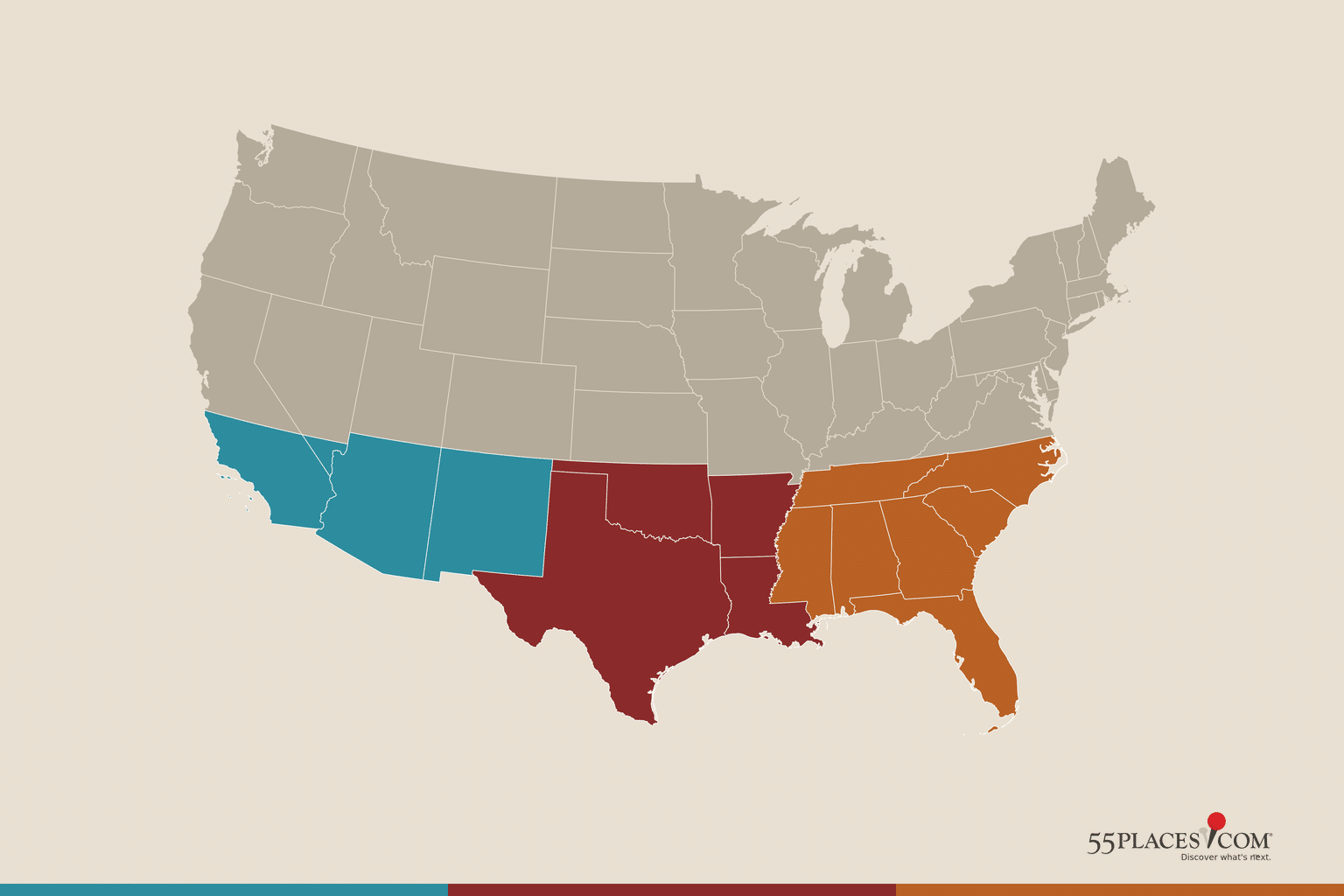
Warm weather is a major draw for retirees considering the Sun Belt. The more important question is where the numbers actually work: taxes, home prices, insurance costs, climate, and the availability of a 55+ community that fits your lifestyle. Several Sun Belt destinations stand out for retirees: Florida, Arizona, Texas, the Carolinas, Georgia, Tennessee, and Nevada.
The Sun Belt continues to attract retirees, but the migration picture is more nuanced than it may seem. From 2015 to 2019, Florida gained an average of 53,150 adults ages 65 and older annually through net domestic migration, more than twice Arizona’s 21,440, according to the U.S. Census Bureau. More recently, just under 266,000 Americans moved for retirement in 2024, down from nearly 340,000 in 2023, according to a HireAHelper analysis of Census Bureau data reported by AARP.
Even as retirement-related moves have declined, six of the top 10 states for moves specifically made for retirement were in the Sun Belt. 55places covers the 55+ market across these destinations. The comparison below examines the trade-offs in taxes, housing costs, insurance, and climate, along with an active adult community that offers a glimpse of daily life in retirement.
| State | No Income Tax? | Avg. Home Insurance ($300K) | Median Home Price (2026) |
|---|---|---|---|
| Florida | Yes | $8,471 | ~$383k |
| Arizona | No (2.5% flat) | $2,397 | ~$437k |
| Texas | Yes | $4,582 | ~$329k |
| North Carolina | No (3.99% flat) | $3,799 | ~$370k |
| South Carolina | No (5.21% top, graduated) | $2,870 | ~$349k |
| Georgia | No (5.09% flat) | $2,301 | ~$360k |
| Tennessee | Yes | $3,198 | ~$373k |
| Nevada | Yes | $1,876 | ~$467k |
Is the Sun Belt Actually Cheaper for Retirees?
Cheaper than the Northeast or West Coast? Often. Uniformly affordable? No. Fidelity identifies four major costs to weigh when considering a move to the Sun Belt: income taxes, property taxes, homeowners insurance, and home prices. The headline benefit you hear most often, no state income tax, is only one part of the equation.
Florida, Texas, Nevada, and Tennessee levy no state income tax, according to the Tax Foundation. That advantage may matter less to retirees who rely primarily on Social Security, since 42 states do not tax those benefits. Housing costs can offset some of the savings: Florida has the nation’s highest average homeowners insurance costs, while Texas has relatively high property taxes, with effective rates around 1.4%, per the Tax Foundation.
Cost of living tells a similarly uneven story. The Missouri Economic Research and Information Center (MERIC) cost-of-living index puts many Sun Belt states below the national average, while Florida comes in slightly above it. Housing, including homeowners insurance, can contribute to Florida’s higher costs, though the index measures several expense categories. The takeaway isn’t that the Sun Belt is expensive; it’s that savings vary by state, making it important to weigh the full cost of living before moving.
1. Florida
Florida stands out for its lack of state income tax, Atlantic and Gulf coastlines, and extensive selection of 55+ communities. It also performs well in U.S. News & World Report’s 2026 Best Places to Retire rankings, with 53 Florida cities among the top 250. Homosassa Springs ranks No. 3 nationally. Explore Florida’s 55+ communities to see what the state offers active adults.
Florida home prices have leveled off, offering buyers some relief. The state’s median sale price is about $383,000 as of September 2026, essentially unchanged from a year earlier. Insurance remains a major expense. Florida homeowners pay an average of $8,471 a year for a policy with $300,000 in dwelling coverage and specified deductibles. That is the highest average in the nation and 195% above the national average, according to Insurance.com.
Storm risk is another factor to plan around. Of those who died in Hurricane Ian in 2022, two-thirds were 60 and older, according to KFF Health News. Standard homeowners insurance policies generally exclude flood damage, which requires separate coverage through the National Flood Insurance Program (NFIP) or a private insurer. The Gulf Coast, Central Florida, and Northeast Florida each have distinct storm risks and insurance costs, which can vary by location. For scale, The Villages in Central Florida has about 70,000 homes, making it the largest age-restricted community in the country.
Well-Suited For: Retirees who want no state income tax, beaches, and a wide range of 55+ communities, and who budget for insurance.
2. Arizona
Arizona pairs relatively low taxes with dry, sunny winters that draw retirees and golfers. The state has a flat 2.5% individual income tax rate, the lowest flat rate in the nation, and exempts Social Security benefits from state income tax, according to the Tax Foundation. Most traditional IRA withdrawals and private pension income are generally taxable at that rate, although certain government and military retirement benefits qualify for exemptions. Property taxes are low, too: Arizona’s effective rate on owner-occupied housing is about 0.48%, according to the Tax Foundation.
Home prices are higher than in many Sun Belt states. Arizona’s median sale price is about $437,000 as of September 2026, with Phoenix at roughly $452,000 and Tucson at $316,000. Homeowners insurance is more moderate, averaging $2,397 a year for a policy with $300,000 in dwelling coverage, according to Insurance.com.
Summer heat is the trade-off to plan around, not dismiss. Phoenix averages about 111 days a year at 100°F or hotter, and in 2024 it recorded a 113-day streak of temperatures at or above that mark. Maricopa County confirmed 608 heat-related deaths that year, according to the county’s public health department. Some retirees manage the heat by choosing higher-elevation towns like Tucson, which is generally cooler than Phoenix, or spending summers farther north. Sun City, developed by Del Webb and opened in 1960, remains a model for active adult living, with 28,000-plus homes and eight golf courses. It is one of the country’s largest active adult communities.
Well-Suited For: Golf-and-desert lovers who want low taxes and can handle the summer heat.
3. Texas
Texas offers the classic no-state-income-tax appeal, often with more house for the money. The state’s median home sale price is about $329,000 as of September 2026. Texas also has several highly ranked retirement destinations: U.S. News’ 2026 Best Places to Retire list placed The Woodlands at No. 4 and Spring at No. 5 nationally.
The caveat is property taxes. Texas has a relatively high effective property-tax rate, around 1.4%, compared with a national average near 0.89%, according to the Tax Foundation. Homeowners insurance adds another significant expense, averaging $4,582 a year for a policy with $300,000 in dwelling coverage, according to Insurance.com. From the Hill Country to the Gulf Coast and major metro areas, Texas offers buyers a wide range of locations and lifestyles. Robson Ranch in Denton is one option for active adults north of Dallas-Fort Worth, with extensive amenities and championship golf.
Well-Suited For: Value-focused buyers who want no state income tax and more house for the money, if they weigh property tax.
4. The Carolinas (North and South Carolina)
The Carolinas offer warm weather, with mountains to the west and Atlantic beaches to the east. North Carolina’s flat individual income tax rate is 3.99% for 2026, according to the Tax Foundation, and both states exempt Social Security benefits from state income tax. South Carolina’s 2026 income tax structure applies a 1.99% rate to taxable income below $30,000 and a 5.21% rate minus $966 to income of $30,000 or more. Residents age 65 and older can claim a deduction of up to $15,000 against South Carolina taxable income, subject to limits for other retirement-income deductions.
South Carolina also has low property taxes, with an effective rate of about 0.49% on owner-occupied homes. Homeowners insurance averages $2,870 a year in South Carolina and $3,799 in North Carolina for policies with $300,000 in dwelling coverage, according to Insurance.com. Summers can be hot and humid, particularly along the coast, but the region offers four-season climates, historic towns, the Lowcountry coast, and the Blue Ridge foothills. Sun City Hilton Head in the Bluffton area is South Carolina’s largest age-restricted community, with more than 8,000 homes and 54 holes of golf.
Well-Suited For: Retirees who want warmth without Florida’s heat and insurance costs, plus history and the coast.
5. Georgia
Georgia offers substantial tax breaks for retirees. The state’s flat income tax rate is 4.99% for 2026, with further reductions planned, and Social Security benefits are exempt from state income tax. Residents ages 65 and older can exclude up to $65,000 in qualifying retirement income per person for 2026, increasing to $70,000 in 2027. This exclusion can significantly reduce the amount of retirement income subject to state tax.
Homeowners insurance averages $2,301 a year in Georgia for a policy with $300,000 in dwelling coverage, about 20% below the national average, according to Insurance.com’s 2026 data. The state offers a range of lifestyles, from the cultural attractions and major medical centers of metro Atlanta to Savannah’s historic districts and moss-draped coastal scenery. Summers can be hot and humid, especially in southern Georgia and along the coast. Georgia also has a wide range of options for active adults, including large 55+ communities such as Sun City Peachtree in Griffin and Cresswind at Lake Lanier in Gainesville.
Well-Suited For: Retirees seeking affordable living, generous retirement-income tax breaks, and a mix of metropolitan amenities and coastal living.
6. Tennessee
Tennessee sits at the northern edge of the Sun Belt, appealing to retirees who want four distinct seasons without the harsh winters found farther north. The state has no individual income tax, according to the Tax Foundation, although its combined state and local sales tax averages 9.61%. Homeowners insurance averages $3,198 a year for a policy with $300,000 in dwelling coverage, according to Insurance.com’s 2026 data.
The state trades some winter warmth for relatively affordable living, scenic lakes, and the Great Smoky Mountains. Nashville, Knoxville, and Chattanooga offer a mix of urban amenities and outdoor recreation, so retirees can spend a morning on a lakeside trail and an evening enjoying live music downtown.
Well-Suited For: Retirees who want no income tax and distinct seasons without harsh winters.
7. Nevada
Nevada makes the desert case with the lowest homeowners insurance costs among the states on this list. It has no individual income tax, according to the Tax Foundation, and homeowners insurance averages $1,876 a year for a policy with $300,000 in dwelling coverage, according to Insurance.com’s 2026 data.
Nevada offers a dry climate and big-city amenities, particularly in the Las Vegas area. Las Vegas and Henderson put golf, dining, and entertainment within easy reach, while Reno offers cooler weather and access to the Sierra Nevada. Both areas offer outdoor recreation, with California destinations and several national parks within driving distance.
Well-Suited For: Retirees who want no income tax, low insurance, and big-city amenities in a dry climate.
How to Choose the Right Sun Belt Destination for You
The right Sun Belt destination depends on which priorities matter most to you. If avoiding individual income tax tops your list, Florida, Texas, Nevada, and Tennessee are worth considering. For lower homeowners insurance costs among the states compared here, Nevada and Georgia stand out. If you prefer summers that are generally less hot than those in much of the Sun Belt, consider the Carolinas and parts of Tennessee. For a broad selection of 55+ communities, Florida and Arizona offer plenty of options, while Texas and some inland metro areas may offer more affordable home prices.
Climate risk can also be a deciding factor. Some retirees are comfortable planning around desert heat, while others prefer to prepare for hurricane season. Each region has its own weather-related risks and costs to consider.
A real estate professional familiar with the local market can help narrow your options. 55places real estate experts specialize in the 55+ market and can help match your budget, lifestyle, and location preferences to specific active adult communities. Connecting with an agent can be a practical next step toward finding a place that fits your retirement plans.
Frequently Asked Questions
Is the Sun Belt actually cheaper for retirees?
Not uniformly. It’s generally cheaper than the Northeast or West Coast, but Florida’s insurance and Texas’ property taxes can offset the savings from no income tax.
Which Sun Belt states have no state income tax?
Florida, Texas, Nevada, and Tennessee levy no state income tax. Several others, including Arizona, the Carolinas, and Georgia, keep rates low and exempt Social Security.
Where is the cheapest warm place to retire in the Sun Belt?
Parts of Texas, Georgia, Tennessee, and the inland Carolinas tend to offer the lowest combined costs. Weigh income tax, property tax, insurance, and home price together rather than any single figure.
Which Sun Belt state has the best 55+ communities?
Florida and Arizona have the deepest concentration of established 55+ communities. That said, every Sun Belt state has strong active adult options.
- Insights and market stats
- Instant new home alerts
- Answers from local 55+ experts