HIGHLIGHTS
- Texas has no state income tax and a lower overall cost of living, while Arizona’s income tax is a flat 2.5%.
- Arizona’s effective property tax rate (0.48%) is roughly one-third of Texas’s (1.4%).
- Texas homes are more affordable (median ~$360K vs. ~$460K in Arizona as of August 2026).
- Both states skip taxing Social Security, but Arizona still taxes pension, IRA, and 401(k) withdrawals at 2.5%.
- Arizona offers dry desert heat and elevation variety; Texas trends hot and humid across its major metros.
Texas and Arizona rank among the most popular retirement destinations in the country, and for good reason: warm weather, no state income tax on Social Security benefits, and a deep bench of established active adult communities.
But the decision between Texas vs. Arizona isn’t as simple as picking a warmer ZIP code. The key differences involve the balance between property and income taxes, the climate you prefer, and the locations of communities that fit your lifestyle. There’s no universal winner, only the state that matches your priorities in retirement.
Texas vs. Arizona: What’s the Difference?
Both states attract buyers with sunshine and favorable tax headlines, but the details matter. Texas has no state income tax, while Arizona levies a flat 2.5% on most income, including pension and 401(k) withdrawals. On the flip side, Arizona’s property taxes run about one-third of what Texas homeowners pay. Housing costs diverge too: Texas homes are roughly $100,000 cheaper at the median. Climate-wise, Arizona’s dry desert heat is a world apart from the humid summers across Houston, Austin, and San Antonio.
| Category | Texas | Arizona |
|---|---|---|
| Cost of living index (MERIC, Q1 2026) | 90.8 | 108.6 |
| Median home listing price (Realtor.com/FRED, August 2026) | ~$359,990 | ~$459,990 |
| State income tax | None | 2.5% flat |
| Effective property tax | ~1.4% | ~0.48% |
| Social Security tax | None | None |
| Climate | Humid and hot | Dry heat, elevation variety |
| Signature 55+ markets | Hill Country, Georgetown, DFW | Phoenix, Tucson, Green Valley |
Cost of Living and Housing
For buyers watching every dollar, the cost-of-living gap between Texas and Arizona is meaningful. According to MERIC’s Q1 2026 data, Texas scores 90.8 on the national cost-of-living index (with 100 as the baseline), while Arizona lands at 108.6. Almost the entire difference comes from housing: Texas’s housing sub-index is 77.2 compared to Arizona’s 120.5.
What does that look like in practice? The median home listing price in Texas runs about $359,990 as of August 2026, according to FRED. In Arizona, the median is roughly $459,990, about $100,000 higher. On a fixed retirement income, that gap can translate to a smaller mortgage, lower monthly costs, or more room in the budget for travel and health care.
That said, statewide medians don’t tell the whole story. Active adult community pricing varies widely in both states, from entry-level attached homes in the low $200,000s to single-family homes well above $500,000 in premium communities near Scottsdale or Austin. The best way to compare is community by community, with verified pricing.
Taxes for Retirees
Taxes are where the Texas vs. Arizona retirement comparison gets tricky, and where many online guides get it wrong.
Texas has no state income tax, per the Tax Foundation. It’s constitutionally prohibited (approved by a 2019 referendum), meaning all retirement income, including Social Security, pensions, IRAs, and 401(k) withdrawals, is free from state income tax.
Arizona levies a flat 2.5% income tax rate to taxable income, according to the Tax Foundation. Social Security benefits are fully exempt, and qualifying military retirement pay is fully deductible. However, private pensions, IRA distributions, and 401(k) withdrawals are subject to the 2.5% tax rate. Arizona also allows a subtraction of up to $2,500 per taxpayer for qualifying pensions from the U.S. government, Arizona state government, or Arizona local governments, but it does not offer a broad exemption for all retirement income.
Here’s the twist: Texas makes up for its lack of an individual income tax with relatively high property taxes. The effective property tax rate on owner-occupied homes in Texas was 1.40% in 2024, compared with 0.48% in Arizona, according to Tax Foundation data. That’s nearly three times the Arizona rate. On a $350,000 home, that translates to approximately $4,900 per year in Texas versus $1,680 in Arizona.
Texas does offer relief for seniors. Homeowners age 65 and older qualify for an additional homestead exemption plus a school district property-tax ceiling (freeze), which can reduce the annual bill.
Tax-by-source breakdown:
- Social Security: Not taxed in either state
- Pensions (private): Not taxed in Texas; taxed at 2.5% in Arizona
- IRA/401(k) withdrawals: Not taxed in Texas; taxed at 2.5% in Arizona
- Property tax: Higher in Texas (1.4%); lower in Arizona (0.48%)
The bottom line: Whether Texas or Arizona comes out ahead depends on the individual’s income mix in retirement. Someone drawing heavily from a 401(k) or pension will pay more to live in Arizona than in Texas. Someone living mostly on Social Security and buying a high-value home may find Arizona’s lower property taxes offset the income-tax difference. Running the numbers for a specific situation, or talking with a tax professional, is worth the effort.
Related Article: The Most Affordable Places to Retire
Climate and Weather
Climate is often the deciding factor, and the two states couldn’t feel more different.
Arizona is known for dry desert heat, and the numbers back up the reputation. Phoenix averages approximately 111 days per year at or above 100°F and about 21 days at or above 110°F, according to National Weather Service 1991 to 2020 climate normals. The heat is intense, but Phoenix’s generally dry climate differs from the humid conditions common along the Gulf Coast. Humidity does increase during Arizona’s summer monsoon season.
Arizona also offers elevation variety that’s easy to overlook. Flagstaff sits at about 6,910 feet, where summer highs rarely top 85°F (though winters bring 100+ inches of snow). Prescott, at roughly 5,000 feet, delivers mild summers with cooler evenings. Arizona isn’t all desert, and many residents take advantage of the seasonal contrast.
Texas runs hot across its major metros, with humidity particularly noticeable in eastern and southeastern parts of the state. Houston has a humid subtropical climate, with hot, humid summers. Austin and San Antonio are generally drier than Houston but still experience long, hot summers, while parts of the Hill Country can be somewhat cooler because of higher elevations.
The key takeaway: Your tolerance for heat and humidity may matter more than the average temperature. Many Arizona active adult communities see residents leave for cooler destinations from June through September (the snowbird rhythm in reverse), which is one way to sidestep the hottest stretch.
Health Care Access
Both Texas and Arizona offer strong health care options for adults 55 and older, especially in metro areas.
Texas is home to the Texas Medical Center in Houston, the world’s largest medical complex. The center includes 54 member institutions and 21 hospitals, according to Rice University, and handles approximately 10 million patient encounters per year. Dallas-Fort Worth, San Antonio, and Austin also have robust hospital systems and specialty care.
Arizona anchors its reputation on Mayo Clinic in Phoenix, ranked the number-one hospital in Arizona for 13 consecutive years and included on the U.S. News national Honor Roll for 2025 to 2026. A $1.9 billion Phoenix-campus expansion was announced in 2025. Phoenix, Scottsdale, and Tucson all have strong health care networks.
In both states, access is strongest near major metros. Buyers planning a move to smaller or more rural communities benefit from researching proximity to hospitals and specialists, and many profiled active adult communities sit within a reasonable drive of major medical centers.
55+ Communities and Lifestyle
This is where the two states feel most distinct, and where the decision becomes personal.
Arizona is the birthplace of the modern active adult community. Sun City, developed by Del Webb, was the first retirement community built specifically for active adults when it opened in 1960, according to NPR. The community set the blueprint for large-scale active adult living: approximately 27,000 homes, eight golf courses, multiple recreation centers, and an on-site hospital. Sun City West, PebbleCreek in Goodyear, The Grand in Surprise, and communities in Tucson and Green Valley continue the tradition. The 55places database profiles around 140 active adult communities across Arizona.
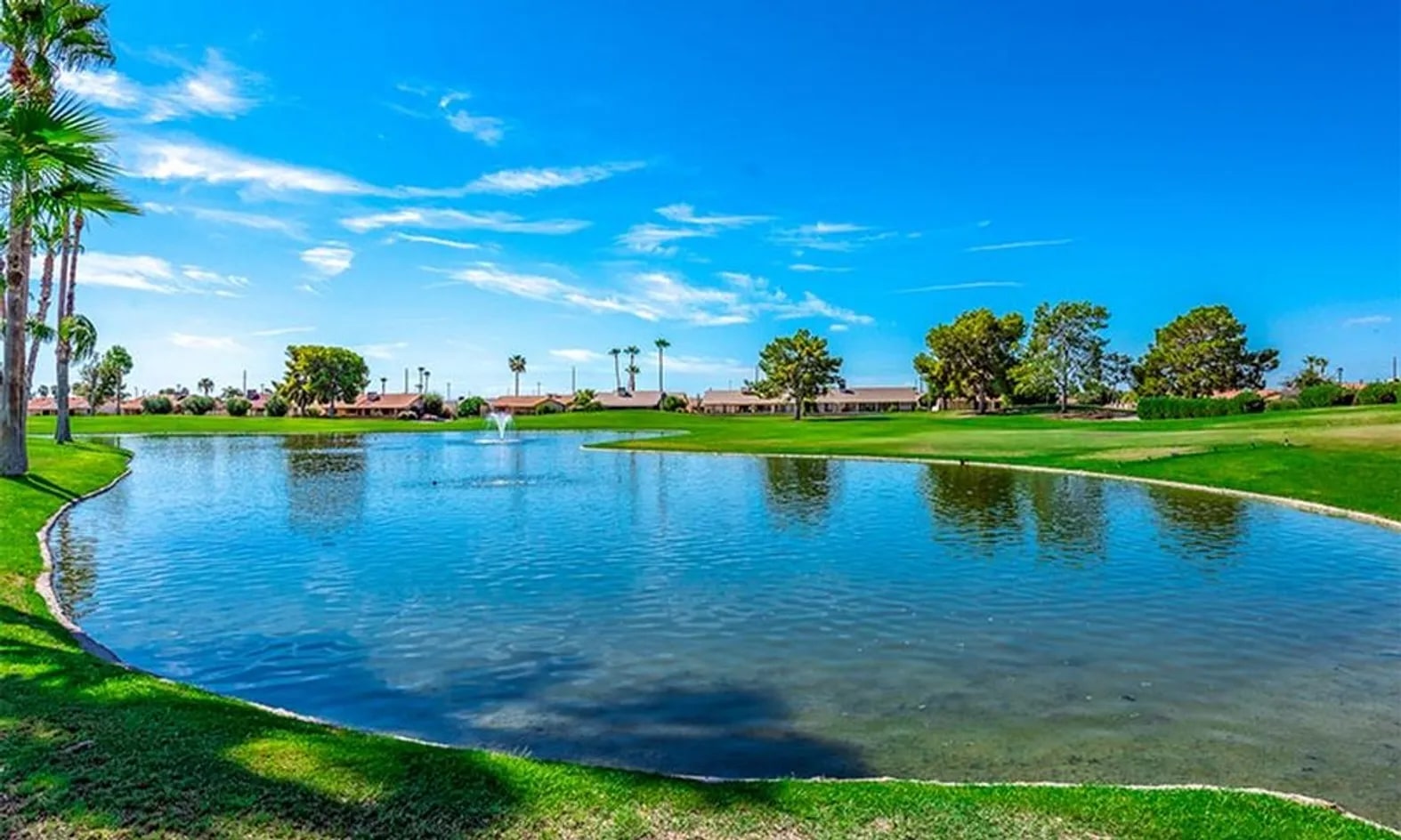
The lifestyle in these active adult communities leans toward desert golf, outdoor fitness, and a rhythm shaped by the seasons. Many residents travel during the hottest summer months and return for the mild fall and spring months. Social calendars fill up quickly, and the “Tuesday morning” picture often includes a morning walk at the rec center, a round of pickleball, and lunch with neighbors.
Texas offers a different flavor. Sun City Texas in Georgetown (outside Austin) draws buyers who want Hill Country scenery and proximity to live music and dining. Robson Ranch in Denton serves the Dallas-Fort Worth market. Del Webb Sweetgrass near Houston and Kissing Tree in San Marcos round out the options. The 55places database profiles roughly 90 active adult communities in Texas.
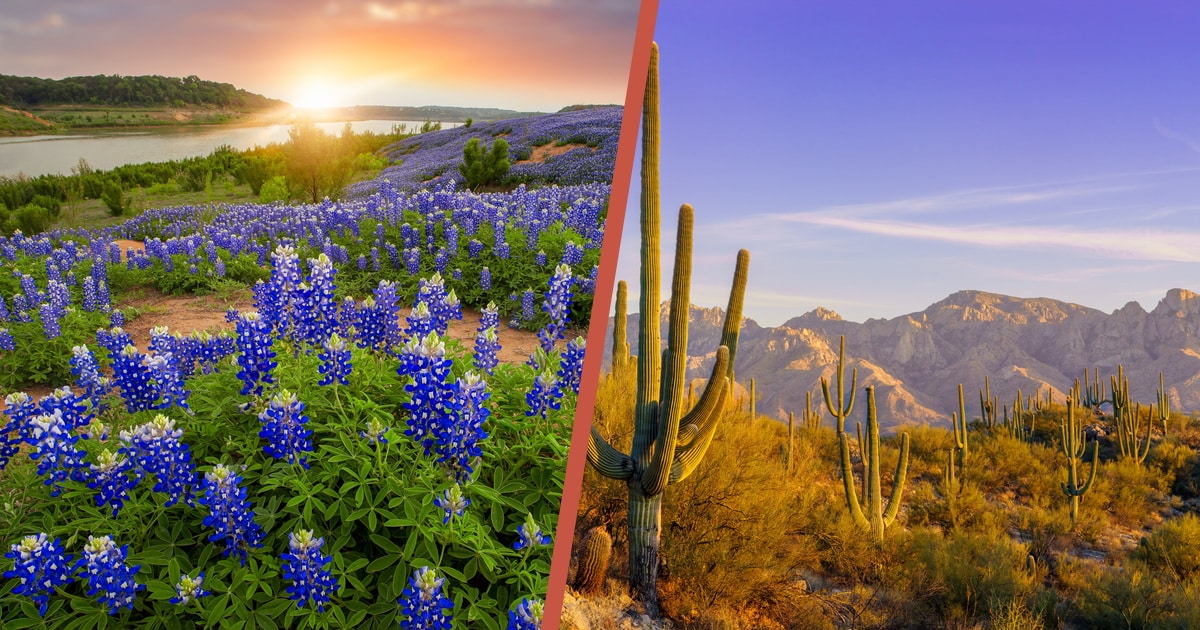
The lifestyle here blends Southwestern hospitality with Gulf Coast and Hill Country culture, from Friday night football to farmers markets and weekend drives through bluebonnet fields. The communities tend to be newer on average, and the buyer pool includes a mix of Texas natives and transplants from the Midwest and Northeast.
Home prices within communities range widely. Entry-level attached homes in both states can start in the low $200,000s, while single-family homes in premium communities near Scottsdale, Austin, or the Phoenix suburbs climb well past $500,000. Verified pricing, resident reviews, and local insight are available for every profiled community.
Related Article: Arizona vs. Florida for Retirement: Which Is Right for You?
Which Is Right for You: Texas or Arizona?
There’s no single answer, but there is a clearer picture once the tradeoffs are laid out.
Choose Texas if the lowest overall cost of living is the top priority, there’s no appetite for any state income tax, retirement income comes heavily from pensions or taxable retirement accounts (which Arizona would tax at 2.5%), and dealing with humidity is manageable. The 65+ homestead exemptions and school-tax freeze help offset Texas’s higher property taxes for qualifying seniors.
Choose Arizona if dry heat is more tolerable than humidity, lower property taxes matter more than avoiding a small income tax, the budget allows for slightly higher home prices, and the retirement income is mostly Social Security (which Arizona doesn’t tax). Arizona’s elevation variety, from the desert to Flagstaff’s cool summers, adds flexibility.
FAQs
Is it cheaper to retire in Texas or Arizona?
Texas has a lower overall cost of living, with a MERIC index of 90.8 compared to Arizona’s 108.6. The gap is driven mainly by housing. Median home prices in Texas run about $100,000 less than in Arizona.
Do Texas and Arizona tax Social Security?
Neither state taxes Social Security benefits. Federal taxes may still apply to a portion of Social Security income depending on total earnings.
Does Arizona tax retirement income like 401(k)s and pensions?
Arizona taxes private pensions, IRA distributions, and 401(k) withdrawals at the flat 2.5% state income tax rate. Social Security and military retirement are fully exempt.
Which state has lower property taxes: Texas or Arizona?
Arizona has significantly lower property taxes, with an effective rate of approximately 0.48% compared to Texas’s 1.4%.
Is Texas or Arizona hotter for retirees?
Phoenix averages about 111 days per year at or above 100°F, but the dry desert heat feels different from Texas’s humid summers. Heat tolerance and humidity sensitivity should guide the choice.
Why do some retirees choose Arizona over Texas?
Many prefer Arizona’s dry climate, lower property taxes, and the state’s deep inventory of established active adult communities, including Sun City, the first large-scale active adult community in the country.
Find the Right Community in Texas or Arizona
Visiting both states, touring communities in person, and talking to residents are still the best ways to get a feel for what each community offers. When the search gets serious, 55places real estate experts specialize in these markets and know individual communities well. Reaching out for a conversation costs nothing and can save months of guesswork. Contact 55places.com today!
- Insights and market stats
- Instant new home alerts
- Answers from local 55+ experts