HIGHLIGHTS
- The core categories: group classes, water workouts, strength training, and balance/fall-prevention programs
- The active-adult twist: court sports like pickleball, tennis, and bocce
- Who runs it: lifestyle directors, certified instructors, and benefits like SilverSneakers
- How to evaluate a community’s fitness offering when you tour
For adults living in 55+ communities, these programs are designed for people who are healthy, mobile, and looking to stay that way. Who leads the classes, whether they’re included in fees, and how well they match what residents actually want to do with their time all shape the experience.
The table below outlines the most common program types, what each one builds, and how communities usually run them.
| Program Type | What It Builds | Typical Format |
|---|---|---|
| Group exercise classes | Cardio, flexibility, social connection | Instructor-led, on-site studio |
| Water aerobics | Joint-friendly strength and cardio | Community or indoor pool, small groups |
| Strength and resistance training | Muscle mass, bone strength | Fitness center, small-group or solo |
| Balance and fall prevention | Stability, confidence | Tai chi or EnhanceFitness-style classes |
| Court sports (pickleball, tennis, bocce) | Agility, competition, community | Community courts, clubs, leagues |
Why Fitness Programs Matter in a 55+ Community
Picture a Tuesday morning: A walking group heads out at 7:30 a.m., coffee with neighbors follows, and water aerobics fills the afternoon. Fitness in an active adult community is less about gym time and more about building a life with movement woven into it.
Federal guidelines recommend that adults 65 and older get at least 150 minutes of moderate aerobic activity per week, plus muscle-strengthening exercises two or more days and regular balance work, according to the CDC. Yet only about 14% of adults 65 and older meet both the aerobic and muscle-strengthening benchmarks during leisure time, according to a CDC National Health Statistics Report published in late 2024. Built-in community programs help close that gap.
There’s a social layer, too. The U.S. Surgeon General’s 2023 advisory found that social isolation raises dementia risk by roughly 50% in older adults. Group fitness is one of the simplest ways to show up regularly, see familiar faces, and build real friendships, which is why Social Life In 55+ Communities often centers on the activities calendar.
Related Article: The Best 55+ Communities For Fitness Fanatics
The Types of Fitness Programs Retirement Communities Offer
Here’s a closer look at the seven program categories most common in 55+ active adult communities.
1. Group Exercise Classes
Group classes are the backbone of most community fitness offerings. Yoga, Pilates, low-impact aerobics, Zumba, dance, and tai chi are staples. Sessions are instructor-led, often held in an on-site studio, and scaled to a range of ability levels.
The format matters as much as the content. Showing up three times a week to the same yoga class creates accountability, and usually a few friendships along the way.
Well-Suited For: Residents who want structure, variety, and company.
2. Water Aerobics and Aquatic Exercise
Water workouts such as aqua aerobics, aquafit, and lap swimming are a staple in any community with a pool. Buoyancy reduces stress on joints, which is why aquatic exercise shows up so often in 55+ communities and why poolside living for active adults remains a top draw.
A 2025 systematic review in Geriatrics found that, compared with no exercise, aquatic exercise significantly reduced pain and improved physical function, including walking ability and balance, for older adults with osteoarthritis across 12 randomized controlled trials.
Well-Suited For: Residents with arthritis or joint sensitivity who want a full workout without the strain.
3. Strength and Resistance Training
Muscle naturally declines with age, a process known as sarcopenia, but it responds well to training. Resistance work two to three times a week significantly improves muscle strength, gait speed, and everyday functional performance, like the timed up-and-go test, in older adults, according to a 2025 review in Aging Clinical and Experimental Research. These strength exercises for seniors are a good place to start.
Communities typically offer free weights, resistance bands, and weight machines in a fitness center, with small-group classes or personal training available. The goal isn’t bodybuilding; it’s maintaining the strength to carry groceries, climb stairs, and stay independent.
Well-Suited For: Anyone focused on staying strong and mobile for the long haul.
4. Balance and Fall-Prevention Programs
Falls affect more than one in four adults 65 and older each year, resulting in roughly 3 million emergency room visits annually, according to the CDC. The health care cost of nonfatal older-adult falls runs approximately $80 billion per year, according to the National Council on Aging.
Tai chi, EnhanceFitness, and SAIL (Stay Active and Independent for Life) are among the evidence-based programs communities offer to address this. A 2026 meta-analysis found that tai chi significantly improves balance and reduces fall risk in older adults, according to research published in Frontiers in Public Health.
Well-Suited For: Residents focused on stability and confidence.
5. Walking Clubs and Low-Impact Cardio
Walking clubs are often the easiest entry point because they have a low bar to entry, are inherently social, and adapt to almost any fitness level. Many communities have trails, and treadmills and stationary bikes fill out indoor options.
Structured walking programs, like Walk with Ease, add a guided plan and a little accountability for residents who want more than a casual stroll.
Well-Suited For: Residents easing into a routine or looking for daily movement with built-in accountability.
6. Court and Racquet Sports (Pickleball, Tennis, and Bocce)
Pickleball courts have become a signature amenity in active adult communities. The sport is now the fastest-growing in the country, with approximately 24.3 million players in 2025, up 171.8% over three years, according to the Sports & Fitness Industry Association. Adults 65 and older made up the second-largest age bracket of players, according to 2023 data.
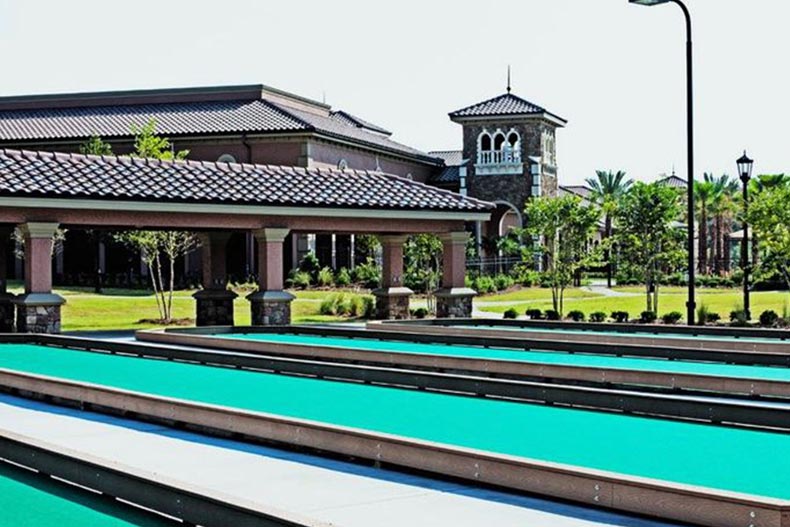
Tennis, bocce, and shuffleboard round out the court-sport offerings. Leagues and clubs add a competitive layer, and the social draw keeps people coming back. Many buyers prioritize pickleball and tennis communities for exactly this reason.
Well-Suited For: Socially competitive residents who want sport as the centerpiece of their fitness life.
7. Chair-Based and Adaptive Classes
Chair yoga, seated strength work, and modified cardio classes ensure residents recovering from injury or managing limited mobility stay active. Adaptive programming keeps everyone included in community life, regardless of where they are physically.
Well-Suited For: Residents who need a seated or modified option and want to stay engaged.
Who Runs the Programs: Lifestyle Directors, Instructors, and SilverSneakers
In many active adult communities, a 55+ community lifestyle director plans and schedules the fitness calendar, coordinating everything from yoga instructors to pickleball leagues. Certified instructors lead individual classes and adapt them to the group’s ability level.
SilverSneakers is a fitness benefit included at no extra cost with many Medicare Advantage plans (and some Medigap plans), according to SilverSneakers. The program provides access to thousands of participating gyms and community centers nationwide. Classes span cardio, strength, water aerobics, yoga, and tai chi. Check your specific plan to confirm coverage.
Some communities offer evidence-based programs recognized by the CDC and the National Council on Aging, including EnhanceFitness, Geri-Fit, SAIL, and Tai Chi for Arthritis. EnhanceFitness, for example, is a group that meets three times per week and covers cardio, balance, strength, and stretching.
How to Evaluate a Community’s Fitness Programs When You Tour
Not every community’s fitness offering will fit every buyer. Here’s what to look for when touring a 55+ community:
- Ask for the current activities calendar and, if possible, drop in on a class to see how it’s run.
- Check the facilities: fitness center hours, pool availability (and whether it’s heated), court conditions, and trail access.
- Ask who leads classes and how programming is planned. A dedicated lifestyle director often signals a more robust offering.
- Confirm what’s included in homeowners association (HOA) dues or community fees versus paid add-ons, ask whether SilverSneakers or similar benefits are accepted, and compare 55+ communities before buying to see how costs stack up.
- Match offerings to your interests and ability today, and consider how they might flex as needs change over time.
Frequently Asked Questions
What fitness programs do retirement communities typically offer?
Most 55+ communities offer seven core types: group exercise classes, water aerobics, strength and resistance training, balance and fall-prevention programs, walking clubs, court sports like pickleball, and chair-based or adaptive classes.
Are fitness classes included in the cost of a 55+ community?
It varies. Many classes are part of community amenities covered by HOA dues, but some add-ons or specialty sessions may carry separate fees, so confirm during your tour.
Does Medicare or SilverSneakers cover fitness at retirement communities?
SilverSneakers is included with many Medicare Advantage and some Medigap plans, providing access to participating gyms and classes. Check your specific plan for details.
What fitness options exist for residents with limited mobility?
Chair-based classes, seated strength training, water aerobics, and adaptive programs offer lower-impact options that keep residents with limited mobility active and engaged.
How often should older adults exercise?
The CDC recommends at least 150 minutes of moderate aerobic activity per week, plus muscle-strengthening exercises two or more days and regular balance work for adults 65 and older.
Find a 55+ Community That Fits Your Fitness Routine
55places Partner Agents specialize in the 55+ market and know individual communities well. They can help connect your fitness priorities with the right community fit. Contact 55places.com today!

- Insights and market stats
- Instant new home alerts
- Answers from local 55+ experts